1986 O-Pee-Chee #53 Patrick Roy RC — The Goalie Who Changed Hockey — Card of the Day
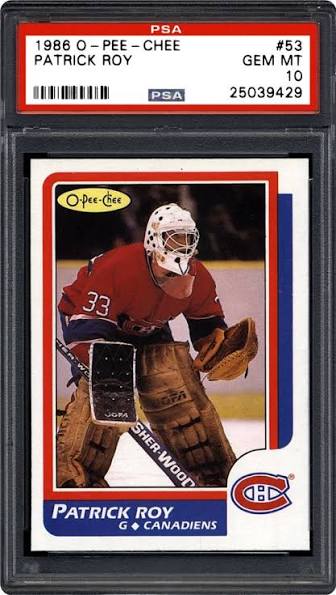
Some cards transcend their cardboard origins to become cultural artifacts — tokens of a moment when greatness first flickered into view. The 1986 O-Pee-Chee #53 Patrick Roy rookie card is exactly that: a snapshot of a 20-year-old goaltender who had just done something no rookie goalie had ever done, and who would go on to redefine his position for generations to come.
The Card
Part of the 1986-87 O-Pee-Chee hockey set — the Canadian-issued counterpart to the Topps release — Patrick Roy's #53 captures the young Quebecer in his Montreal Canadiens white jersey, staring with a calm intensity that would become his trademark. Where the Topps version shows Roy in a posed headshot, the O-Pee-Chee issue features a full-uniform action pose that better captures the energy of a 20-year-old who had just taken the NHL by storm.
The 1986-87 O-Pee-Chee set contains 264 cards and is particularly beloved by collectors for its Canadian heritage and generally sharper photography compared to the US Topps release. The set is anchored by two titanic rookie cards: Mario Lemieux's #9 and Patrick Roy's #53 — arguably the two most consequential hockey rookies of the 1980s.
Why This Card Matters
Patrick Roy didn't just win — he redefined what a goaltender could be. Over his 19-season NHL career:
- Four Stanley Cups (1986, 1993 with Montreal; 1996, 2001 with Colorado)
- Three Conn Smythe Trophies as playoff MVP — the only player in NHL history to win with two different teams
- Three Vezina Trophies as the league's top goaltender
- 551 career regular-season wins — an NHL record at the time of his retirement
- 151 playoff wins — also an NHL record at retirement
- First-ballot Hockey Hall of Fame induction in 2003
More than the stats, Roy changed how the position was played. His butterfly style — dropping to his knees to cover the bottom of the net, challenging shooters with aggressive positioning — became the standard that every modern goaltender follows. Before Roy, goalies stood up; after Roy, they dropped. The game literally looks different because of him.
O-Pee-Chee vs. Topps: The Collector's Choice
The 1986-87 Patrick Roy rookie exists in two versions: the US Topps issue (card #53 in that set) and the Canadian O-Pee-Chee issue (also #53). While both are legitimate rookie cards, the O-Pee-Chee version commands a significant premium due to:
- Lower print runs — O-Pee-Chee produced fewer copies for the Canadian market
- Canadian heritage — Roy is a Quebec-born icon, and the O-Pee-Chee brand carries extra meaning for Canadian collectors
- Scarcity in high grade — O-Pee-Chee cards of this era are notoriously tough in high grades due to softer card stock and less careful handling by Canadian kids in the 1980s
This scarcity is reflected in the population numbers: just 94 PSA Gem-Mint 10 examples exist for the O-Pee-Chee version, compared to significantly more in the Topps release. A PSA 10 O-Pee-Chee Roy is not just a graded card — it's a needle-in-a-haystack find.
PSA Population Report
| PSA Grade | Population | Value |
|---|---|---|
| PSA 10 | 94 | $8,975 |
| PSA 9 | 824 | $1,375 |
| PSA 8 | 1,952 | $625 |
| Total Graded (All Grades) | 5,616 | — |
* Population data as of July 11, 2026.
Market Context
The O-Pee-Chee Roy RC occupies a fascinating position in the hockey card market. It's not as expensive as Gretzky's O-Pee-Chee rookie (which commands five figures even in mid-grade), but it's the definitive goaltender rookie card in the hobby — the card every hockey collector targets when they want to anchor their goalie collection.
Entry points are reasonable for a Hall of Fame legend: a PSA 8 can be found in the $500-$700 range, while PSA 9 examples trade between $1,200 and $1,800. The PSA 10, with its tiny population of 94, is the trophy piece — typically commanding $8,000-$12,000 when they appear at auction, and they don't appear often.
For context, this card pairs naturally with the blog's recent coverage of the Jack Hughes/U.S. hockey card surge (#0156). Where Hughes represents the future of hockey collecting, the O-Pee-Chee Roy represents its foundation — the kind of card that belongs in every serious hockey collection alongside Gretzky, Lemieux, and Orr.
Verdict: The 1986 O-Pee-Chee #53 Patrick Roy RC is a foundational hockey card — affordable at mid-grade, spectacular at the top, and historically essential. Collectors building a hockey portfolio should consider a PSA 8 or 9 as the smart value play versus chasing the ultra-rare PSA 10.