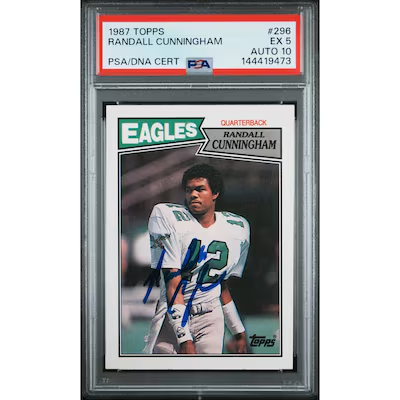
Card of the Day: 1987 Topps Randall Cunningham #296 — The Quarterback Who Changed the Position
Randall Cunningham didn't just play quarterback differently — he redefined what the position could be. Before Cunningham, the mobile quarterback was a gimmick. After Cunningham, it became the blueprint. His 1987 Topps rookie card, card #296 in one of the most iconic sets of the junk wax era, captures a player who arrived five years too early for the league that would eventually bear his stylistic DNA.
The Card That Defined an Era
The 1987 Topps football set is a landmark issue for several reasons. It was the first Topps football set to use full-bleed photography, giving each card a modern, vibrant look that the bordered designs of previous years lacked. The set includes rookie cards of Jim Kelly, Doug Flutie, and Charles Haley — all Hall of Famers or near-Hall of Famers. But the card that has emerged as the set's most iconic is the Randall Cunningham #296, featuring the Eagles' quarterback in his white home jersey with the classic silver eagle helmet, set against a deep green background.
The card number itself — 296 — is notable within the set's structure. It places Cunningham among the veterans and stars in the final third of the checklist, a designation that reflected his status as a promising young player rather than the icon he would become. The 1987 set was printed during Topps' peak production years, meaning raw copies are abundant. But high-grade examples tell a different story.
PSA Population Report
| PSA Grade | Population | Value |
|---|---|---|
| GEM-MT 10 | 136 | $875 |
| MINT 9 | 1,545 | $50 |
| NM-MT 8 | 2,267 | $15 |
| Total Graded (All Grades) | 4,949 | — |
* Population data as of June 12, 2026. PSA population counts are dynamic and increase as more cards are submitted for grading.
With a gem mint rate of just 2.75%, the Cunningham rookie is genuinely scarce in PSA 10. The 136 examples that have earned the top grade represent a tiny fraction of the total population — a reflection of the centering and print quality issues that plagued high-production Topps sets of the era. For context, the current PSA Price Guide values a PSA 10 at $875, while a PSA 9 commands just $50. The spread between 10 and 9 — a ratio of more than 17-to-1 — signals that the 10-grades are held tightly by set registry collectors who understand the card's true scarcity in premium condition.
Why Cunningham Matters
Cunningham's statistical resume — 4× Pro Bowl, NFL MVP in 1990, 29,979 passing yards, 207 touchdowns, 4,928 rushing yards — tells only part of the story. His true impact was evolutionary. Before Cunningham, the quarterback position was defined by pocket presence. After Cunningham, the term "dual threat" entered the football lexicon. He was the first quarterback to rush for over 600 yards in four consecutive seasons, and his 942 rushing yards in 1990 stood as the single-season record for a quarterback until Michael Vick broke it in 2006.
He led the Philadelphia Eagles to four playoff appearances in six seasons from 1988 to 1993, dragging teams with middling supporting casts deep into January. His 91-yard punt against the Giants in 1989 — on a fourth-down desperation boot that he launched with his left foot despite being right-footed — remains one of the most legendary individual plays in NFL history.
The verdict: Cunningham's 1987 Topps rookie card is undervalued relative to his historical significance. The 2.75% gem rate means PSA 10s are genuinely scarce — rarer than the pop numbers suggest when adjusted for the card's total printed quantity. For collectors building a portfolio of iconic 1980s rookies, the Cunningham #296 belongs in the same conversation as the Montana, Marino, and Elway cards from the same era. The 17-to-1 PSA 10 premium over PSA 9 suggests the market already knows this — but the absolute price point ($875 for a PSA 10 of a position-defining Hall of Famer) still looks cheap compared to comparable cards in baseball and basketball.