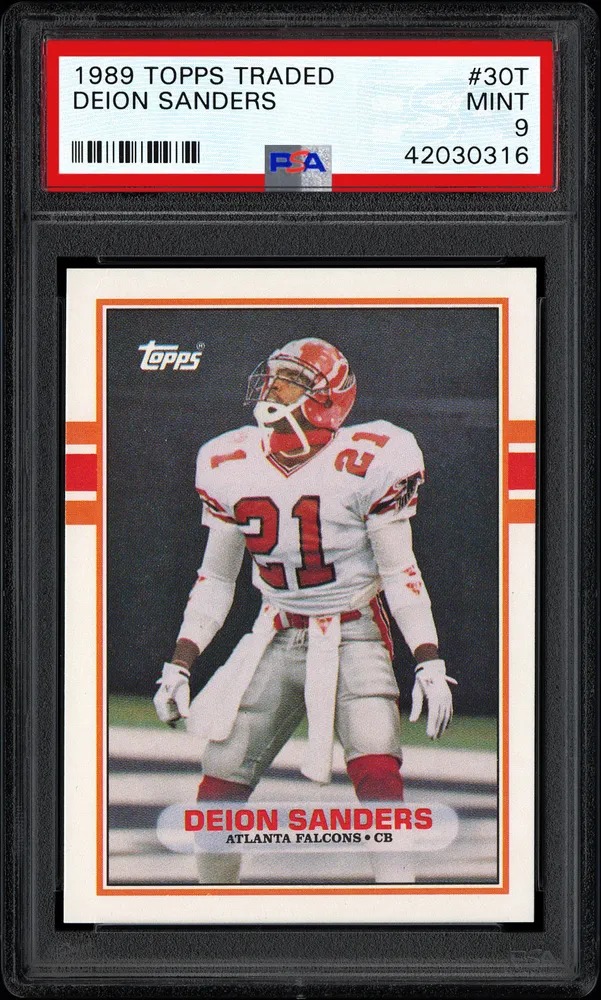
Card of the Day: 1989 Topps Traded #30T Deion Sanders RC
4,202. That is how many PSA 10s exist of the 1989 Topps Traded Deion Sanders rookie — out of 12,130 graded. More than a third of every copy PSA has ever seen came back perfect.
This is the exact inverse of the cards we have run all week, and it is worth putting side by side: the 1969 Reggie Jackson has one PSA 10 in 11,749 (CASE #0240). The 1971 Lafleur has six in 2,185 (CASE #0246). Deion has four thousand two hundred and two.
Why This Card Is Different
1989 Topps Traded was not sold in packs. It was issued as a complete boxed set — cards went from the factory into a sealed box, and from that box into a closet. No pack searching, no shoebox, no rubber bands, no bicycle spokes. The handling that destroys vintage cardboard simply never happened to most of these.
You can read that history straight off the population ladder, which is upside down compared to every vintage card we cover:
PSA Population Report
| PSA Grade | Population | Value |
|---|---|---|
| PSA 10 | 4,202 | $95 |
| PSA 9 | 5,631 | $20 |
| PSA 8 | 1,801 | $10 |
| Total Graded (All Grades) | 12,130 | — |
* Population data as of August 14, 2026.
Look at the PSA 8 row. There are fewer NM-MT 8s than there are Gem Mint 10s. On a vintage card the population pyramid is wide at the bottom and comes to a point at the top; here it bulges at 9 and stays fat at 10, because the failure mode was never wear. It was centering and print quality on cards that were otherwise untouched.
What Perfection Costs When It Isn't Rare
The PSA 10 carries a $95 Price Guide value. The 9 is $20. The 8 is $10.
That is the whole economics of the era in three rows. Grading a card like this costs a meaningful fraction of what the graded card is worth, which is why the 8s and 9s in the population are mostly collateral damage — copies submitted in hope of a 10 that came back a grade or two short.
Compare the Lafleur from CASE #0246: a $1,300 PSA 9 from a total population of 2,185. Deion's card is a Hall of Famer's rookie too. The difference is not the player, the design, or the demand. It is that one card was printed for a small Canadian market in 1971 and handled by children, and the other was sealed in a factory box in 1989 and never touched.
The Player Was Never the Problem
Deion Sanders went fifth overall to Atlanta in 1989, and the card shows him in the Falcons' white road uniform, #21, helmet on, waiting. He is the only person to play in both a Super Bowl and a World Series — two Super Bowl rings, an appearance in the 1992 Series with the Braves — and he entered the Pro Football Hall of Fame in 2011.
A career like that would carry a $10,000 rookie card in almost any other era. This one is $95 in a PSA 10, and that is not a verdict on Deion Sanders. It is a verdict on 1989.
Verdict: misdemeanor. One of the most electric athletes of the century, a genuinely great-looking rookie card, and a print run so generous that the perfect copy costs less than dinner. The crime was committed by the printing press, not the player.