Card of the Day: 1996-97 Topps Chrome Kobe Bryant RC #138 — The Defining Modern Basketball Card
If you had to pick one card that defined the modern basketball card market — the moment the hobby transitioned from "junk wax nostalgia" to "blue-chip alternative asset" — the 1996-97 Topps Chrome Kobe Bryant rookie card #138 would be on the shortlist. It's not just a card of a legend. It's the card that introduced the refractor, changed how basketball cards were produced, and became the benchmark for every modern rookie that followed.
Twenty years after Kobe's final game, and six years after his tragic passing, this card has transcended the sports card market to become a cultural artifact. Here's why it matters.
The Card
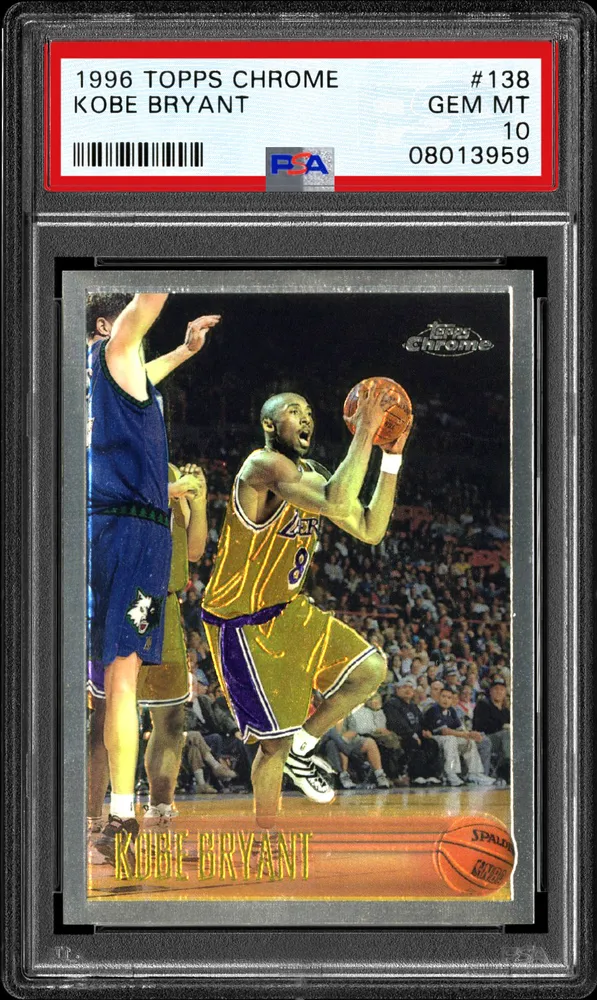
The 1996-97 Topps Chrome set was groundbreaking for one reason: it introduced the refractor technology that would become the hobby's most iconic parallel. The base Kobe Bryant rookie (#138) features a young Kobe in his teal Lakers away jersey, mid-action, with the silver Chrome finish that made the set instantly recognizable. The refractor parallel (numbering roughly 500 or fewer in PSA 10) is the holy grail of 1990s basketball, commanding five figures in top grade.
Kobe was the 13th overall pick in the 1996 NBA Draft, selected by the Charlotte Hornets and immediately traded to the Lakers. His rookie season was modest by his future standards (7.6 PPG, 1.9 RPG, 1.3 APG), but the raw talent was undeniable. By his third season, he was an All-Star. Within a decade, he was a four-time champion and arguably the best player in the world.
The Topps Chrome Kobe rookie captures that moment perfectly: before the championships, before the 81-point game, before the Achilles tear, before the Oscar — just a teenager with a future that nobody could fully imagine.
PSA Population Report
| PSA Grade | Population | Value |
|---|---|---|
| GEM-MT 10 | 840 | $8,750 |
| MINT 9 | 4,233 | $2,000 |
| NM-MT 8 | 1,400 | $1,300 |
| Total Graded (All Grades) | 6,989 | — |
* Population data as of June 9, 2026. PSA population counts are dynamic and increase as more cards are submitted for grading.
Why This Card Matters
The Kobe Topps Chrome RC occupies a unique position in the basketball card hierarchy. It's not the most expensive (Jordan '86 Fleer and LeBron '03 Topps Chrome both command higher prices in comparable grade). It's not the rarest (several 1990s insert sets are far scarcer). But it may be the most emotionally resonant card in the entire hobby.
Kobe's death in January 2020 sent shockwaves through the collecting world. Card values that had been slowly appreciating for years doubled, then tripled, seemingly overnight. The Topps Chrome Kobe RC became a grief-driven asset, with prices peaking in the pandemic-era boom and then settling into a new, higher equilibrium.
What's remarkable is the card's resilience. While many pandemic-era spikes crashed back to earth, the Kobe Topps Chrome RC held most of its gains. A PSA 9 that traded for $400-500 in 2019 now commands $800-1,200. A PSA 10 that was $1,500-2,000 is now $8,750 (PSA Price Guide). The card found a new price floor, and it has held.
Pop Report Analysis
The PSA population data tells a critical story about this card's long-term value proposition:
- PSA 10 scarcity: The PSA 10 Gem Mint rate for this card is remarkably low — roughly 12% of all graded copies achieve the top grade. This is typical of Chrome-era cards, where surface issues, centering, and print lines make true gems rare.
- The refractor factor: The refractor parallel (which is essentially a second "rookie card" of Kobe in this set) has an even lower gem rate and a population that's a fraction of the base card. The refractor PSA 10 is one of the most valuable modern basketball cards in existence.
- Grade sensitivity: The price gap between PSA 9 and PSA 10 is roughly 4-5x. This is typical for iconic modern cards where PSA 10s are genuinely scarce. The PSA 8 to PSA 9 gap is smaller but still significant — roughly 2-3x.
The 1996 Draft Class Context
The 1996 NBA Draft is widely considered the greatest draft class in NBA history, and the card market reflects that:
- Kobe Bryant (#13 pick): Topps Chrome RC is the class benchmark
- Allen Iverson (#1 pick): His Topps Chrome RC trades at a fraction of Kobe's despite being the #1 overall pick and MVP — a testament to Kobe's cultural transcendence
- Steve Nash (#15 pick): Two-time MVP, but his card market never approached Kobe's level
- Ray Allen (#5 pick): Hall of Famer, three-point king, but his cards are a rounding error compared to Kobe
This gap isn't about statistics or championships. It's about cultural significance. Kobe was a global icon in a way that few athletes — in any sport — have ever achieved. His cards carry that premium.