1999 Pokémon #2 Blastoise Holo 1st Edition: Rain Dance, a Two-Peak Curve, and 101 PSA 10s in 4,116
Card No. 2 of the first English Pokémon set is a water turtle with two cannons on its shell and a power that got around the game's own Energy rule. PSA has graded 4,116 copies of the 1st Edition holo, and its most common grade is a 9.
The Card
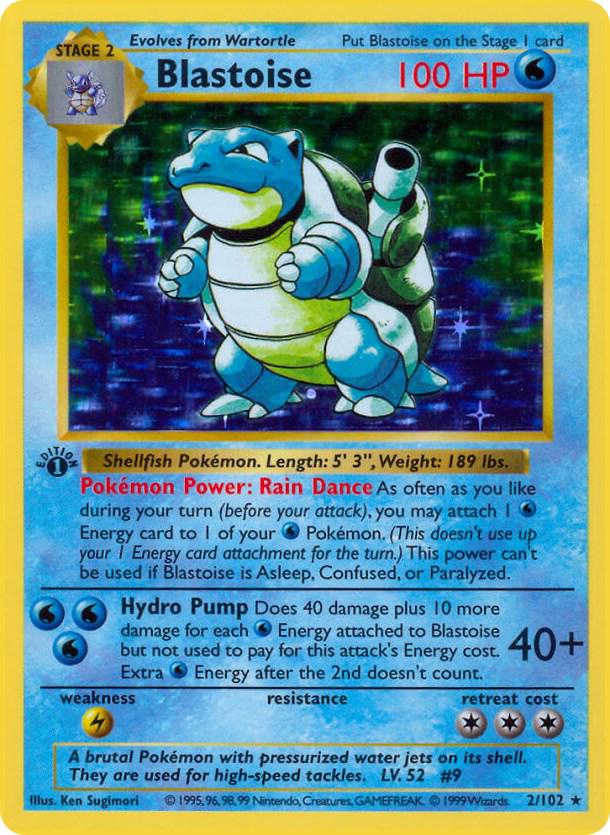
The English Base Set went on sale on Jan. 9, 1999, printed by Wizards of the Coast, and its 102 cards open with the holographic rares. Blastoise is 2/102. Ken Sugimori drew it: the Pokémon stands square to the viewer, fists up, one shell cannon angled skyward, against a starry holofoil background that throws light when the card is tilted.
The 1st Edition version carries a small black "Edition 1" stamp on the left edge, just below the art box and beside the yellow info bar. That stamp marks the first print run of the English set.
Everything else is the original 1999 template. A Stage 2 badge in the top corner shows the small Wartortle it evolves from. The red "100 HP" sits beside a Water symbol. Down at the bottom, the Pokédex line describes "a brutal Pokémon with pressurized water jets on its shell," used "for high-speed tackles," and gives its level as 52 and its number as #9.
What It Did on the Table
Blastoise was a card people played as well as kept, and the reason is printed in red across the middle of it.
Rain Dance is a Pokémon Power. As often as you like on your turn, it lets you attach a Water Energy card from your hand to any of your Water Pokémon, and the card spells out that this does not use up your normal one-Energy-per-turn attachment. The only limit is that Blastoise cannot use it while Asleep, Confused or Paralyzed.
Its attack, Hydro Pump, costs three Water Energy and does 40 damage, plus 10 more for each extra Water Energy attached, up to two. With Rain Dance doing the loading, that cap was easy to reach.
The rest of the stat line is the price of all that. Blastoise is weak to Lightning and has a retreat cost of three, so once it was in front, it tended to stay there.
PSA Population Report
| PSA Grade | Population |
|---|---|
| PSA 10 | 101 |
| PSA 9 | 716 |
| PSA 8 | 653 |
| Total Graded (All Grades) | 4,116 |
* Population data as of October 29, 2026. PSA population counts are dynamic and increase as more cards are submitted for grading.
Reading the Population
This curve has two peaks, and that is the most interesting thing about it.
The first is in the middle, at PSA 5, with 620 copies, and PSA 6 is close behind at 599. Those are the cards that were shuffled and played, which is exactly what this card was printed for.
The count dips at PSA 7, to 537, then climbs again. The second peak is at the top: PSA 9 is this card's single most common grade, with 716 copies. That is the mark of a card that a lot of people also pulled and put away almost at once, and of the copies that have been sent in since.
The 10s are where it narrows. There are 101 of them, about one gem mint copy for every 41 graded, and the 9s outnumber them roughly seven to one. A holofoil front is unforgiving: scratches and print lines on the foil, plus the yellow border that shows any off-center cut, keep most well-kept copies a grade short.
The full straight-grade curve:
- PSA 10: 101
- PSA 9: 716
- PSA 8: 653
- PSA 7: 537
- PSA 6: 599
- PSA 5: 620
- PSA 4: 406
- PSA 3: 230
- PSA 2: 133
- PSA 1: 107
- Authentic: 14
PSA also lists 43 copies at 8.5, the most of any half grade on the card.
Verdict: the first card in the English Base Set's holo run, carrying a power that bent the Energy rule for Water decks. It survived both as a played card and as a kept one, and the population shows both lives. A 9 is the grade most collectors will find, and the 101 10s are the copies that came through more than 27 years without a mark on the foil.