2006 Topps #334 Devin Hester RC — 366 PSA 10s in 661, and the Card Calls Him a Cornerback
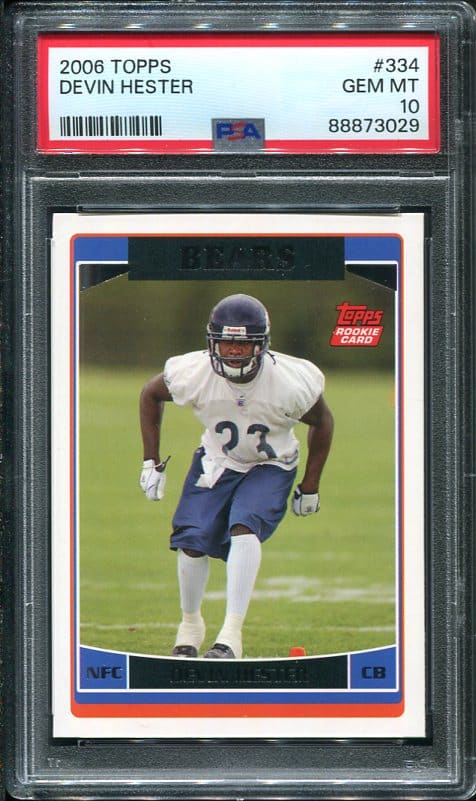
The last four football cards to run in this slot produced twelve PSA 10s between them. This one produced 366. PSA has assigned a straight grade to 661 copies of the 2006 Topps Devin Hester rookie, and more than half of them came back a 10.
The card itself has no idea what it is looking at. The front is a minicamp photograph — white practice jersey, number 23, no crowd, no opponent, a rookie running a drill on an empty practice field. The nameplate reads DEVIN HESTER. The position box beside it reads CB. Topps printed him as a cornerback, because in the spring of 2006 that is what the Chicago Bears had drafted. The Trading Card Database lists him at #334 in the 2006 Topps set, flagged as a rookie card, and the Topps ROOKIE CARD shield is on the front to confirm it.
PSA Population Report
| PSA Grade | Population |
|---|---|
| PSA 10 | 366 |
| PSA 9 | 197 |
| PSA 8 | 55 |
| Total Graded (All Grades) | 661 |
* Population data as of September 1, 2026. PSA population counts are dynamic and increase as more cards are submitted for grading.
Read the Whole Curve, Not the Top Row
A four-row table flattens this card. Here is the full straight-grade distribution PSA published this morning: one PSA 3, five 4s, six 5s, sixteen 6s, fifteen 7s, fifty-five 8s, 197 9s and 366 10s. Three half-grade copies exist and no qualified ones, which puts 664 Hester rookies in PSA holders all told.
That is a population stacked at the ceiling. The PSA 9 and PSA 10 rows hold 563 of the 661 straight grades. Everything graded 7 or below — every copy with visible handling — comes to 43 cards, six and a half percent of the total.
Set that against what has run in this slot over the past week. The 1971 Topps Joe Greene rookie has 3,296 straight grades and no PSA 10 at all (CASE #0287). The 1974 Topps Ray Guy has 741 and three (CASE #0293). Jan Stenerud's 1970 Topps rookie has 762 and nine (CASE #0290). Bronko Nagurski's 1935 National Chicle has 187 and none (CASE #0284).
Analysis: Thirty-two years separate the Ray Guy card from this one, and the gap in the numbers is a gap in manufacturing and handling, not in merit. A 2006 card was cut on modern equipment, pulled from a pack by someone who already knew to put it in a sleeve, and submitted for grading by people buying with the grade in mind. A 1974 card spent its first decade in a shoebox. PSA publishes the counts; it does not publish a reason, and nothing in the data assigns one. What the counts do establish is that a Hester 10 is a common object and a Ray Guy 10 is not.
The Season the Card Missed
Topps printed a cornerback. What arrived that autumn was a return man who, in the Pro Football Hall of Fame's words, set NFL records that are still standing.
Chicago took Hester in the second round of the 2006 draft, 57th overall. In the rookie season this card predates, he returned 47 punts for 600 yards and three touchdowns, brought 20 kickoffs back for 528 yards and two more, and ran a missed field goal 108 yards to the end zone — which the Hall of Fame counts as one of only five such scores in an NFL game. The Bears went 13–3 and reached Super Bowl XLI, which Hester opened with a 92-yard kickoff return for a touchdown. The Hall notes that no one else has ever done that in a Super Bowl.
He was not finished. In 2007 he returned four kickoffs and two punts for scores, an NFL record for combined kick-return touchdowns in a season, including a game against Denver in which he took back both a 75-yard punt and an 88-yard kickoff. In 2010 he led the league with 564 punt-return yards and three touchdowns and earned a third first-team All-Pro selection. Across 156 regular-season games he scored on 14 punt returns and five kickoffs.
The Hall of Fame enshrined him with the Class of 2024 and lists his position as PR / KR / WR — the return roles first. He holds one of the two return-specialist places on the NFL 100 All-Time Team and was named to the All-Decade Team of the 2010s.
The Verdict
This blog has spent the past week on the positions football cards usually skip: the offensive line, the defensive line, the placekicker, the punter. Hester is the return man, and his card is the one that breaks the pattern in every direction at once. It is modern where the others are vintage, common where the others are scarce, and a 55 percent gem rate where the others are at or near zero.
It also carries the one thing none of the others do — a position box that is simply wrong about what the player turned out to be. Topps had the Bears' depth chart and printed CB. Nine months later the man on the card had returned a kickoff for a touchdown to open a Super Bowl.
366 gem copies is not scarcity, and this card has never pretended otherwise. What it has is the best joke in the 2006 set: a rookie card that catalogs a cornerback and accidentally documents a Hall of Fame returner, photographed at practice, under the position box of a defensive back.