1969 Topps Planet of the Apes #38 The Search! — Tied for the Most PSA 10s in the Set, and More Than Half Its Slabs Stopped at Eight
Four copies of this card have graded PSA 10. The entire 44-card set has produced fifty-six, and no card in it has produced more than four.
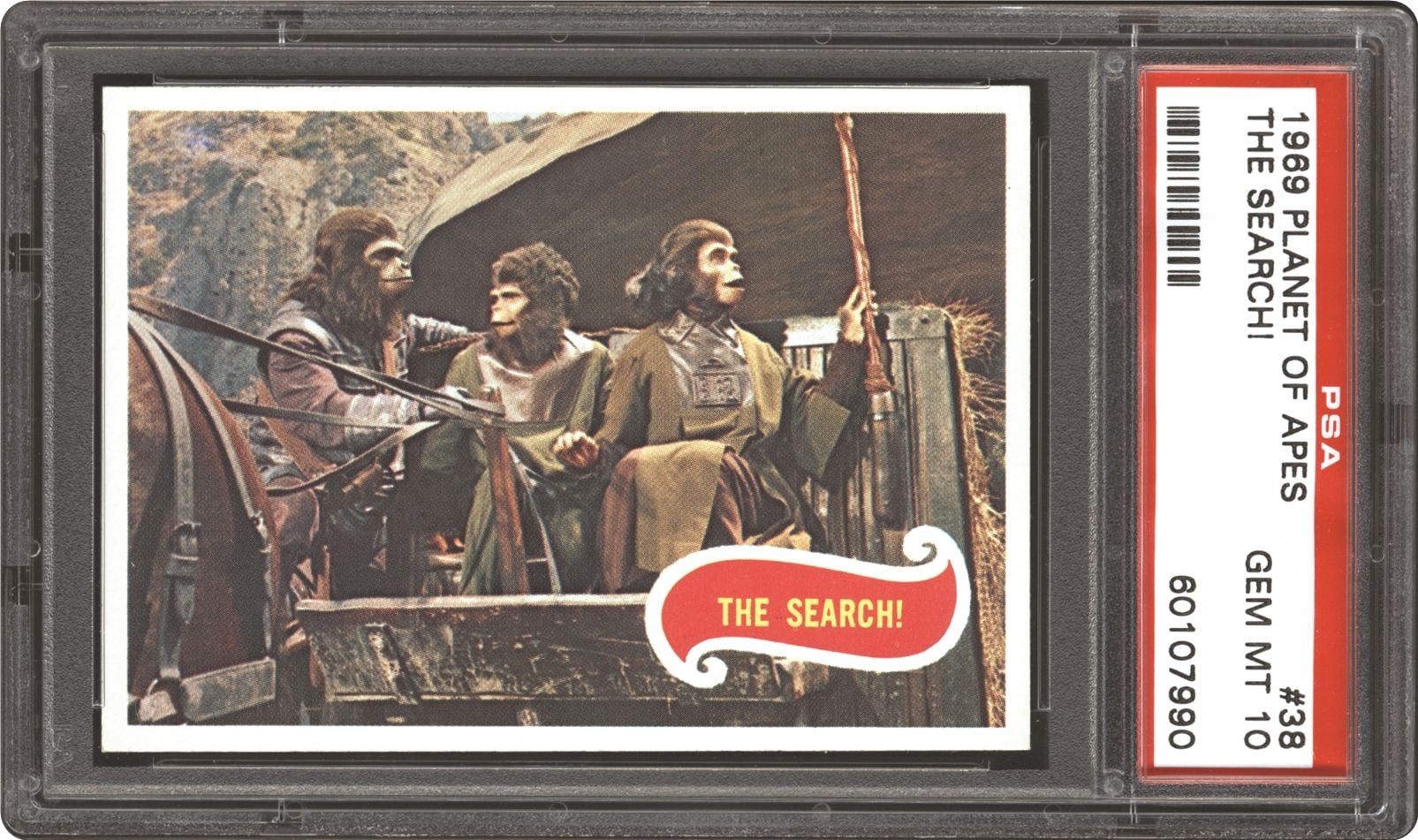
1969 Topps Planet of the Apes is a 44-card set of stills from the 1968 film, each one captioned in a red scroll across the bottom of a horizontal photo. Card #38 is The Search! — three apes riding a wagon out of a rock cutting, one of them standing with a rifle raised. It is not the card anyone in this set chases. It is, by a measure nobody publishes, one of the two best-graded cards in it.
PSA Population Report
| PSA Grade | Population |
|---|---|
| PSA 10 | 4 |
| PSA 9 | 10 |
| PSA 8 | 28 |
| Total Graded (All Grades) | 53 |
* Population data as of September 14, 2026. PSA population counts are dynamic and increase as more cards are submitted for grading.
What the Whole Set Looks Like
CardFacts assigns this set a sequential block of identifiers, one per card number, so all 44 cards can be pulled individually rather than estimated from one. This blog walked every one of them.
Across the full checklist, PSA has issued 2,058 straight grades, plus 78 half grades and 144 qualified grades. Of those 2,058, exactly 56 are PSA 10s — a gem rate of 2.72% for the set as a whole. Nine of the 44 cards have never produced a single one.
Card #38 holds four of the fifty-six. Only #26, Ape Scientist!, matches it, and it matches it exactly — four PSA 10s from its own 53 straight grades. Nothing else in the set has more than three. On its own population, #38 gems at 7.55%, close to three times the set's rate.
And It Is Not the Popular Card
The obvious explanation for a card leading a set's gem count is that it has been submitted more than everything else, so it has had more chances. That is not what happened here.
With 53 straight grades, #38 sits mid-pack. Ten cards in the set have been submitted more often and five others are tied with it at exactly 53. The set's most-graded card is #22, Taylor's Ally!, at 67, followed by #21 Caged! and #24 Human on a Leash! at 62 apiece. Not one of the ten cards ahead of it has four tens; the best any of them has managed is three.
The Eight Wall
The rest of the curve explains why four is a high number here rather than a low one.
Twenty-eight of this card's 53 straight grades are PSA 8 — 52.8% of everything graded, more than half. Set-wide, PSA 8s account for 40.6% of straight grades, so this card piles up at the eight considerably harder than its neighbours do. In raw count, its 28 eights are the second-heaviest PSA 8 population in the set, behind only #22's 32.
What is missing is just as telling. This card has no straight grade below EX 5, and only one of those. Below the eight sit three EX-MT 6s and seven NM 7s — eleven cards in total. Forty-two of the 53 straight grades are NM-MT 8 or better.
That is the profile of a card that survived in decent shape and then met a ceiling. The copies coming back are clean enough to clear an eight and then stall there; ten have cleared the nine, and four have cleared everything.
The Slab in the Picture
The example pictured above is one of those four. Its flip reads 1969 PLANET OF APES · THE SEARCH! · #38 · GEM MT 10, cert 60107990 — PSA's own cert record confirms the grade, lists PSA Population 4 for the card, and puts PSA Pop Higher at 0, which is what a ten at the top of a curve looks like from inside PSA's database. The holder currently sits in a public Set Registry set.
The flip is also slightly shorter than PSA's own catalogue entry: the label says Planet of Apes where the cert record says Planet of the Apes. It grades the same either way.
The verdict: a mid-pack card by submissions and a top card by results. Nine cards in this set have never produced a PSA 10 and #38 has produced four of the set's fifty-six — while more than half of its own population stopped at the eight. Misdemeanor.