A Researcher Says Card Packs Already Meet the Legal Definition of Gambling — and That Regulators Aren't Enforcing It
Leon Y. Xiao, an assistant professor at City University of Hong Kong, says the pack of trading cards on a store shelf already satisfies the legal definition of gambling in most jurisdictions — and that the reason it is not regulated as gambling is that the law covering it is not being enforced.
Xiao, a visiting research fellow at King's College London who studies loot boxes, gacha mechanics and consumer protection law, made the argument in a Q&A published by Gambling Insider on Oct. 6. It rests on a study he co-authored that appeared in the Journal of Behavioral Addictions on Aug. 18, which measured how little the packs themselves tell the people buying them.
That study sampled 50 physical card packs in Hong Kong. Eighty percent carried no probability disclosure on the packaging — no odds, and no link to any. The other 20 percent published something, but the researchers found it insufficient, occasionally difficult to find and, in some cases, misleading. No pack, the study reports, let a buyer know the odds of getting every individual card.
The paper's own conclusion is narrower than the interview. It states that "worldwide, there is currently no dedicated card pack regulation," and argues that in the absence of gambling law, consumer law should be enforced against "gambling-like products" — naming physical Pokémon packs, Labubu blind boxes and video game loot boxes — to mandate transparency. Xiao goes further in the Q&A. "Card packs should constitute gambling under both the common-sense definition and the legal definition, but regulators are not enforcing gambling law properly," he told Gambling Insider. "So, in practice, card packs are not currently regulated as gambling, which is why we called them 'gambling-like.'"
His reading of the law turns on a single element. The line most jurisdictions draw, he says, is whether a prize can be transferred to a third party and therefore carries real-world monetary value — which is exactly what a chase card has, because it can be sold. "My opinion is that these products, including the original card packs, are gambling according to the legal definitions of most jurisdictions," he said of packs, breaks and repacks. Breaks and repacks, he added, "are riskier because more money is risked than with normal packs and so the potential harm is greater," and they carry fraud questions of their own: whether a repack is fair, and whether it actually contains the rare cards it advertises.
It is not a new position for him. In July, Xiao told the hobby publication Kanto Post that mystery packs and repacks specifically are "just plain illegal, unlicensed gambling." TheGamer covered that exchange, and it described what the claim was: one legal analysis, not a formal ruling.
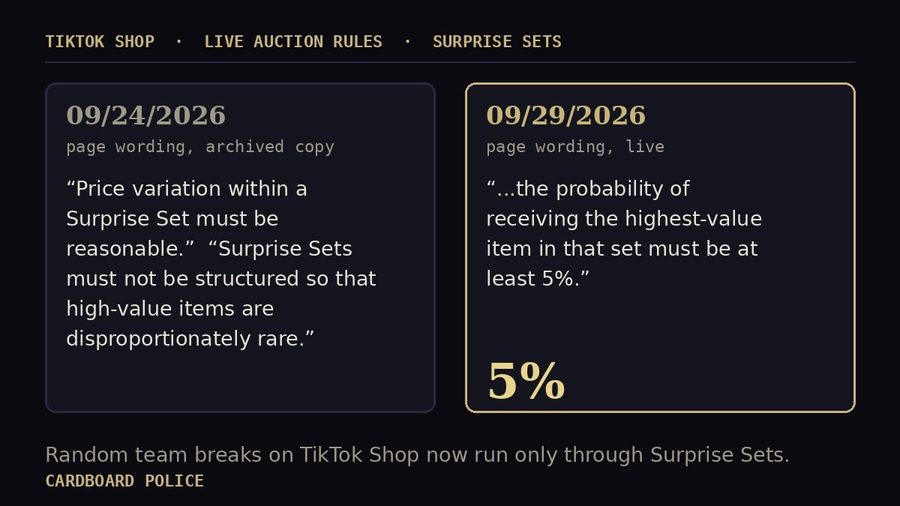
Analysis: The two ends of this market have been moving in opposite directions. Physical packs, the study found, mostly tell buyers nothing. The platforms selling randomized product online have started telling them something. GameStop's Power Packs display value-range odds before purchase (CASE #0353), and TikTok's rules for Surprise Set breaks, dated Sept. 29, require at least a 5% chance at the highest-value item in a set (CASE #0350). Those are disclosure moves, and Xiao's position is that disclosure is the floor rather than the fix.
Probability disclosures are "not enough," he said. "More enforcement action is urgently needed for the other issues identified, particularly to protect children." Asked whether the definition of gambling is being stretched too far, he said the line could be redrawn in both directions — to cover products that fall outside the current legal definition but are demonstrably more harmful, such as loot boxes, and to exempt products that meet it but are not obviously risky, such as blind boxes. He did not propose what a redrawn line would say.
Xiao's central claim is an argument, not a finding, and the study does not report that any regulator has accepted it. What the research does establish is narrower and harder to dispute: the transparency that consumer law already requires is, on 50 sampled packs, mostly absent — and the product holding the most valuable cards is the one sold to children.
The pack in the child's hand is the same random-draw product the law defines as gambling, and nobody has had to answer for that yet.
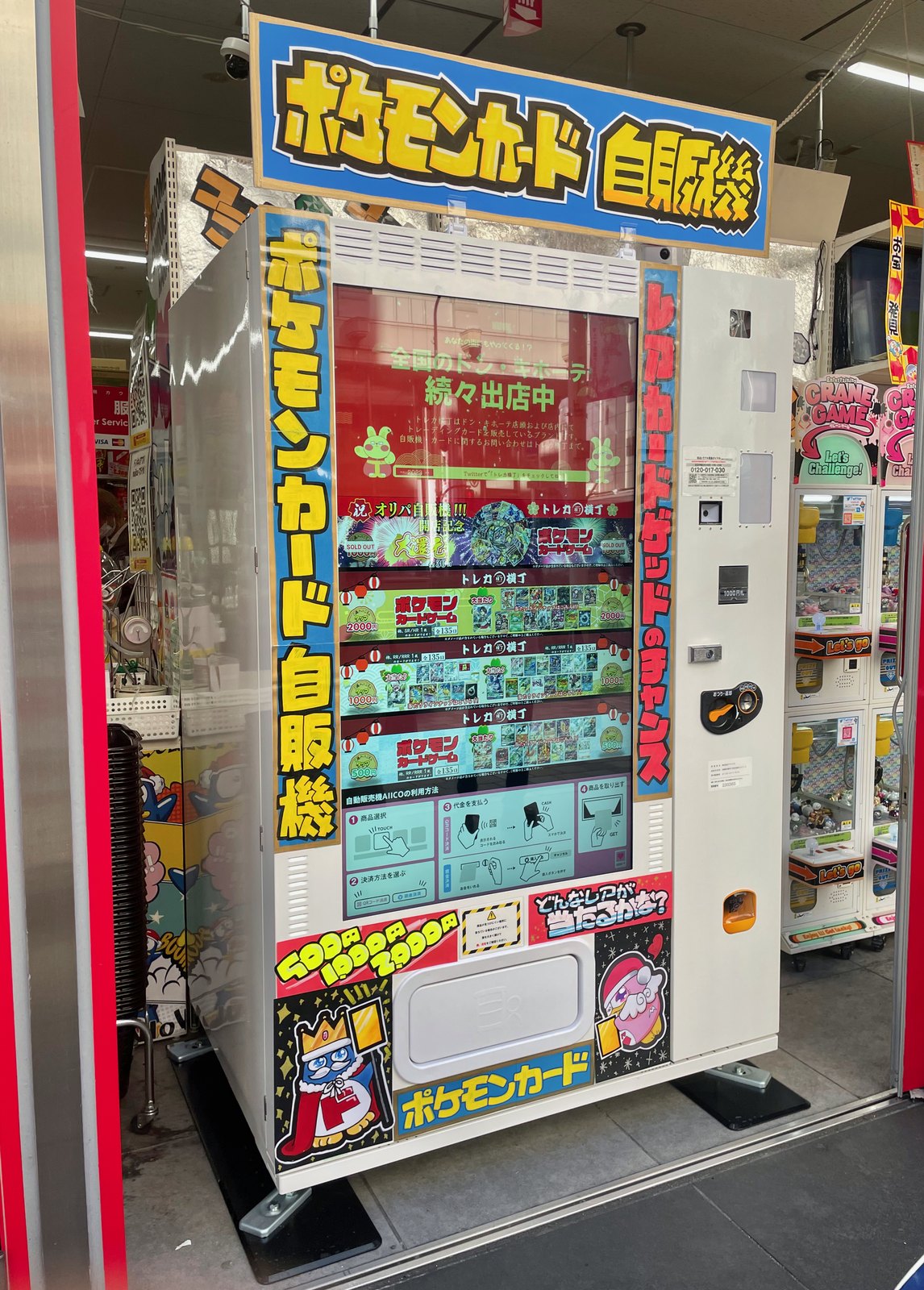
Sources: Leon Y. Xiao's interview with Gambling Insider, published Oct. 6, 2026; "Unpacking non-transparency: Most physical trading card game and collectible sports card packs failed to disclose probabilities for winning rare prizes," Lo, Xiong and Xiao, Journal of Behavioral Addictions, published Aug. 18, 2026 (DOI 10.1556/2006.2026.00197), abstract and results verified through Crossref; TheGamer's July 22, 2026 report on Xiao's comments to Kanto Post. The GameStop Power Packs and TikTok Surprise Set rules are from this blog's own reporting in CASE #0353 and CASE #0350. Featured image: "Pokémon Trading Card Vending machine" by KKPCW (Kyu3), Wikimedia Commons, CC BY-SA 4.0.