The Chicago Bears Are Moving to Indiana — What It Means for the Football Card Market
The Chicago Bears are crossing state lines. On June 4, the Bears Board of Directors voted to advance a stadium development project in Hammond, Indiana — a decision that ends a six-year stadium saga and opens a new chapter for one of the NFL's most historic franchises. For the sports card market, the question is immediate: what happens to the value of everything with a "C" on the helmet?
The Vote That Shook Chicagoland
On June 5, the Bears dropped a joint statement from team president Kevin Warren and chairman George H. McCaskey: "The Chicago Bears Board of Directors met and voted to advance our stadium development project in Hammond, Indiana, with the exact site to be selected."
The announcement came four days after the Illinois legislature adjourned without passing a stadium authority bill that would have kept the team in-state. Indiana, by contrast, had already done the work — passing Senate Bill 27 in February to create a Northwest Indiana Stadium Authority with the financing structure for a domed, year-round facility.
The likely footprint sits near Wolf Lake, a 326-acre parcel that currently houses the Lost Marsh Golf Course, with the BP Whiting Refinery as an unlikely backdrop. Hammond Mayor Tom McDermott didn't hide his enthusiasm: "The Chicago Bears chose Hammond, Indiana because they see what I have said for years: Hammond is a successful city of opportunity and possibility."
Illinois Governor JB Pritzker's office fired back: "The Bears have built a storied legacy in Illinois for over 100 years but have spent the last six years shifting their position on a stadium location." Chicago Mayor Brandon Johnson's office was more measured, noting the vote "does not mean a move to Hammond is a done deal."
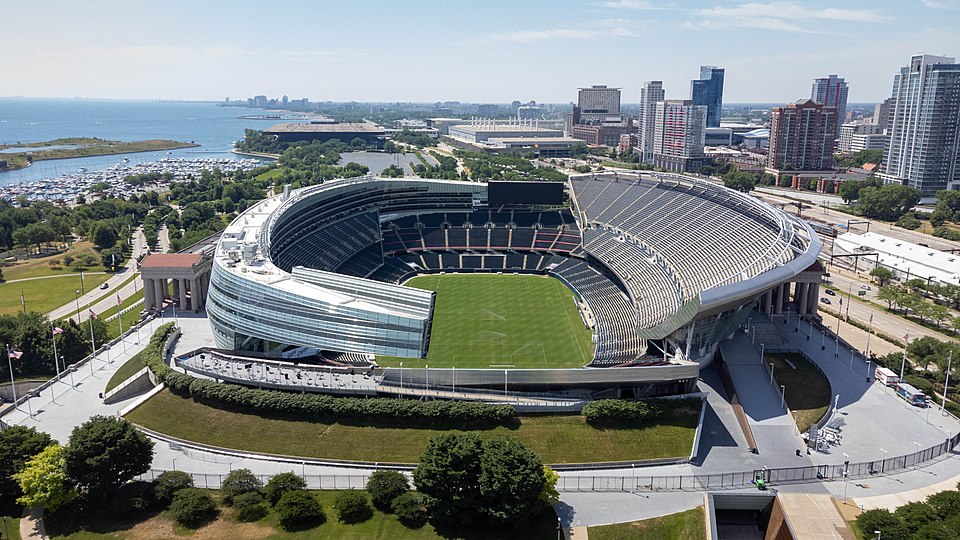
But make no mistake: this is the closest the Bears have ever come to leaving Illinois. Soldier Field has been home since 1971 — a 55-year run that appears to be ending.
The Card Market Question: What Happens to "Chicago"?
For collectors holding everything from vintage Walter Payton rookies to Caleb Williams Prizm parallels, the immediate concern is branding. Will future cards still say "Chicago Bears"?
Almost certainly yes. The precedent is well-established:
- San Francisco 49ers — Play in Santa Clara, 45 miles from San Francisco. Cards and branding unchanged.
- New York Giants and Jets — Both play in East Rutherford, New Jersey. Still "New York" on every product.
- Los Angeles Rams — Play in Inglewood. Cards never said "Inglewood Rams."
- Dallas Cowboys — Play in Arlington. No one calls them the Arlington Cowboys.
The NFL understands brand equity. "Chicago Bears" is a billion-dollar trademark. No one in the league office or at Panini/Topps is going to print "Indiana Bears" — and the Hammond location is in the Chicago metropolitan area anyway. The team name isn't changing. Neither are the uniforms. For card collectors, the on-card product will look identical.
What Team Relocations Do to Card Prices — The Historical Record
The hobby has seen this movie before, and the data tells a consistent story:
Raiders: Oakland → Las Vegas (2020). The move to Allegiant Stadium injected massive energy into the Raiders brand. Derek Carr rookies spiked. Vintage Ken Stabler and Marcus Allen cards — which had already priced in the Oakland mystique — saw a modest bump. The Raiders became a "destination" collectible. New stadium, new fans, new money entering the market.
Rams: St. Louis → Los Angeles (2016). Returning to LA after 21 years in St. Louis created an immediate surge in Rams card demand. The Aaron Donald rookie card market — already strong — exploded further when the team's national profile grew. LA is a media multiplier. St. Louis Rams cards became nostalgic curiosities — a niche market within a market.
Chargers: San Diego → Los Angeles (2017). The move that most closely resembles what Bears fans fear. The Chargers left a loyal fanbase in San Diego to become LA's second team. Card values for Justin Herbert rookies are strong, but the "San Diego" nostalgia premium on LaDainian Tomlinson and Junior Seau cards is real and persistent. Collectors pay a premium for the San Diego-era uniforms and card designs.
The pattern: new stadiums drive short-term demand spikes (new fans, media attention, product releases). Vintage cards from the team's prior era develop a nostalgia premium over time — the "remember when" factor that collectors pay for.
The Bears Cards That Matter Most
The Bears have one of the deepest vintage catalogs in football. Here's what the move means card-by-card:
Walter Payton 1976 Topps RC (#148). PSA 10 population under 20. Last sale in PSA 8: $2,500–$3,500. Payton is untouchable — his legacy is cemented in Chicago regardless of where the team plays. This card moves on condition scarcity and Payton's GOAT status, not stadium location. Hold.
Dick Butkus 1966 Philadelphia RC (#31). One of the most iconic football cards ever made. PSA 8 examples push $5,000+. Butkus is Chicago football. If anything, nostalgia for the "real Chicago Bears" era could push these higher as fans romanticize the Soldier Field years.
Gale Sayers 1966 Philadelphia RC (#38). The "Kansas Comet" in a Bears uniform. PSA 8 at $1,500–$2,000. Same dynamic as Butkus — vintage Bears legends are location-proof.
Caleb Williams 2024 Prizm Silver RC. The face of the franchise. His cards are the most liquid in the modern Bears market. A move to Indiana with a new domed stadium could actually benefit Williams — indoor football favors his passing game. If the fan backlash causes a short-term dip, that's a buying opportunity.
Rome Odunze 2024 Prizm RC. Second-year upside. Lower entry price than Williams, similar stadium math.
Justin Fields 2021 Prizm RC. Already in Pittsburgh. His Bears-era cards are now a closed set — the last "Chicago Bears" quarterback cards before the potential move. Nostalgia play if he develops in Pittsburgh.
Verdict
The Bears' move to Hammond, Indiana is a seismic regional story with a surprisingly muted hobby impact. The "Chicago Bears" brand isn't going anywhere — neither the name nor the uniform will change. Vintage Bears cards (Payton, Butkus, Sayers) are location-proof assets driven by condition scarcity, not stadium zip codes. Modern rookies like Caleb Williams may benefit from the energy of a new domed stadium. The one wildcard: fan emotion. If Chicago-based collectors sell out of frustration in the short term, smart money buys the dip. The Bears are the Bears — regardless of which side of the state line the stadium sits on.