Dick's Sporting Goods Is Building Card Shops Inside Its Stores — and Sent Buyers to the National to Stock Them
Dick's Sporting Goods does not buy its inventory at flea markets. It buys hoodies and gloves and golf clubs from manufacturers, in bulk, on contracts. So the detail worth stopping on in The Athletic's August 18 report is this one: Dick's sent a team of buyers onto the floor of the National Sports Collectors Convention to shop for individual cards off dealer tables.
That is how a hobby shop stocks a display case. It is not how a national retail chain stocks its shelves.
What Is Actually Being Built
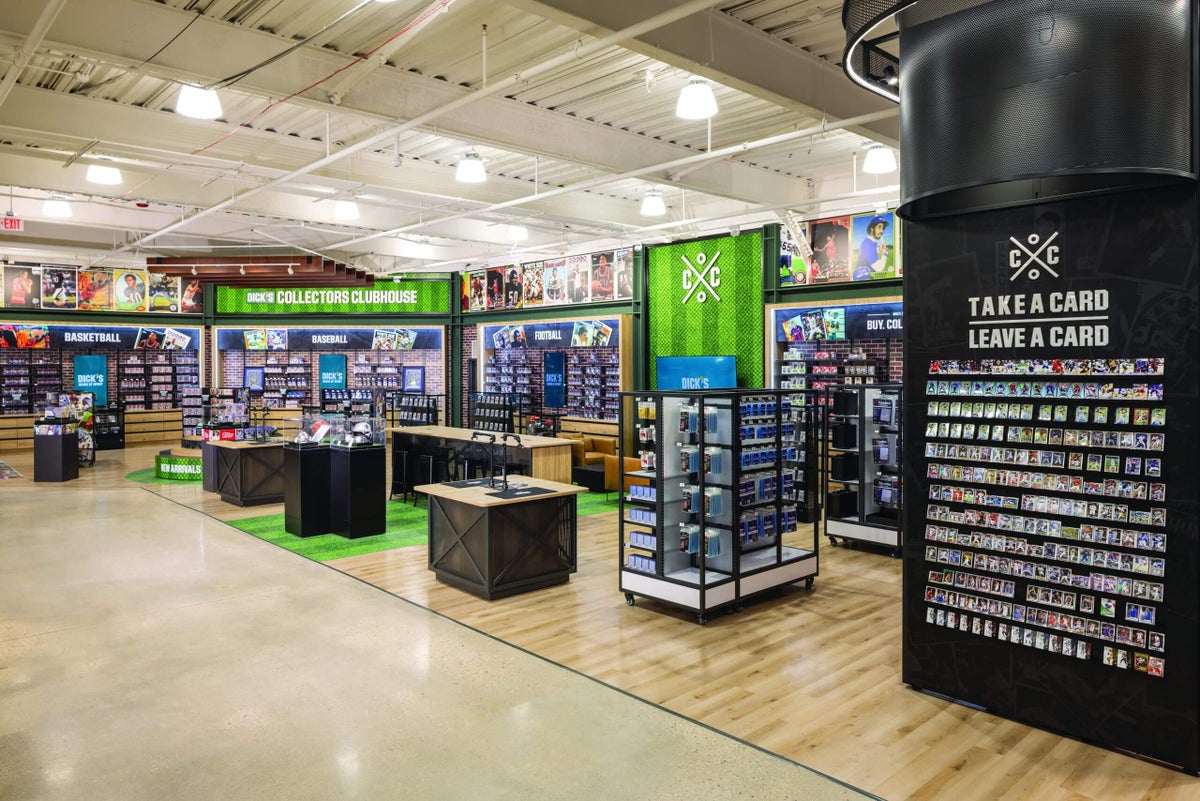
Per The Athletic's Larry Holder, Dick's is creating "Collectors Clubhouse" areas inside its "House of Sport" locations — the company's oversized store format, the ones with batting cages, climbing walls and golf simulators. The pictured build-out, at the House of Sport in Schaumburg, Illinois, shows what that means in practice: card walls segmented by sport under Basketball, Baseball and Football headers, glass cases, a new-arrivals bin, and a community "TAKE A CARD / LEAVE A CARD" board running the height of a pillar.
The stated goal is a hobby-shop atmosphere carrying both sealed product — hobby and retail — and singles, aimed at longtime collectors and first-timers at once.
Dick's has sold sealed boxes from Topps and Panini for years, so this is not the company discovering trading cards. The pivot is singles, and the company is candid that it is learning on the job.
"We're developing our muscle," senior vice president of hardlines David Progar told The Athletic. "We think having a really good singles assortment is critical to our success in this business." He also described it as "a totally new business and different business for us," crediting card-collecting employees for helping with negotiations.
The Number That Explains The Strategy
Progar gave the reason the company kept expanding after early tests: the data on who buys cards. Card customers, he said, "shop more frequently than our traditional consumer, which we really liked."
That is the whole thesis. Cards are not being treated as a category that must justify itself on its own margin — they are being treated as a reason to walk in the door more often, with the rest of the store waiting. The Athletic reports that Target's trading card space became a billion-dollar revenue stream last year, and that Walmart and GameStop are expanding their card footprints as well.
The margin math got raised directly on the company's first-quarter earnings call in late May. Chief financial officer Navdeep Gupta said the collectibles push created "a little bit of a mix headwind" on gross margin, which prompted an analyst question about collectibles being a source of pressure. President and CEO Lauren Hobart pushed back on the framing rather than the figure: the business has "a lower margin than our overall mix," she said, but "thinking of them as pressure or any sort of negative thing is the wrong way to look at it. It's incremental gross margin dollars, bringing people in more frequently, appealing to a younger audience." Hobart did not quantify what cards contributed in the quarter.
The Card In The Pittsburgh Store
The purchase that announced Dick's arrival came in March 2025, when it paid $1.11 million for the Paul Skenes one-of-one 2024 Topps Chrome Update MLB Debut Patch autographed rookie card. Per sales database Card Ladder, it remains the most expensive Topps Debut Patch card ever publicly sold — a record scoped to that specific card type, not to cards generally.
Dick's outlasted a field that included the Pittsburgh Pirates, who offered 30 years of season tickets behind home plate. Progar said bidding on Fanatics Collect ran past midnight with no fixed ceiling. The card now sits in the Pittsburgh House of Sport, and the company has not decided what to do with it next.
Analysis: This blog has tracked the retail push from the transactional side — GameStop's rejected $56 billion eBay bid (CASE #0063) and StockX Live's card launch (CASE #0251) were both about owning the marketplace. Dick's is doing something structurally different: putting a staffed, physical singles counter in a suburban shopping center, in the same building as the treadmills. The risk is the one every hobby shop already knows — singles require someone who can price them, and a chain that buys wrong at a card show eats the difference. The frequency data explains why Dick's considers that worth learning. Whether the assortment holds up is a question only the next few quarters answer.
Sources: The Athletic (Larry Holder, August 18, 2026) for the Collectors Clubhouse plan, the House of Sport format, the National buying trip, all Progar/Gupta/Hobart quotes, the Q1 earnings-call exchange, the Target billion-dollar figure and the $1.11 million Skenes purchase; Card Ladder, via The Athletic, for the Topps Debut Patch record; Fox News/OutKick (Matt Reigle, August 18, 2026), which credits The Athletic, for corroboration of the Clubhouse plan and the Skenes purchase. The Analysis passage is this blog's interpretation, not a finding in either report.