PSA Says the Holder on a US$660,000 "PSA 10" Shiny Rayquaza Is Fraudulent. Dexerto Reports Copy Labels With Real Cert Numbers on AliExpress
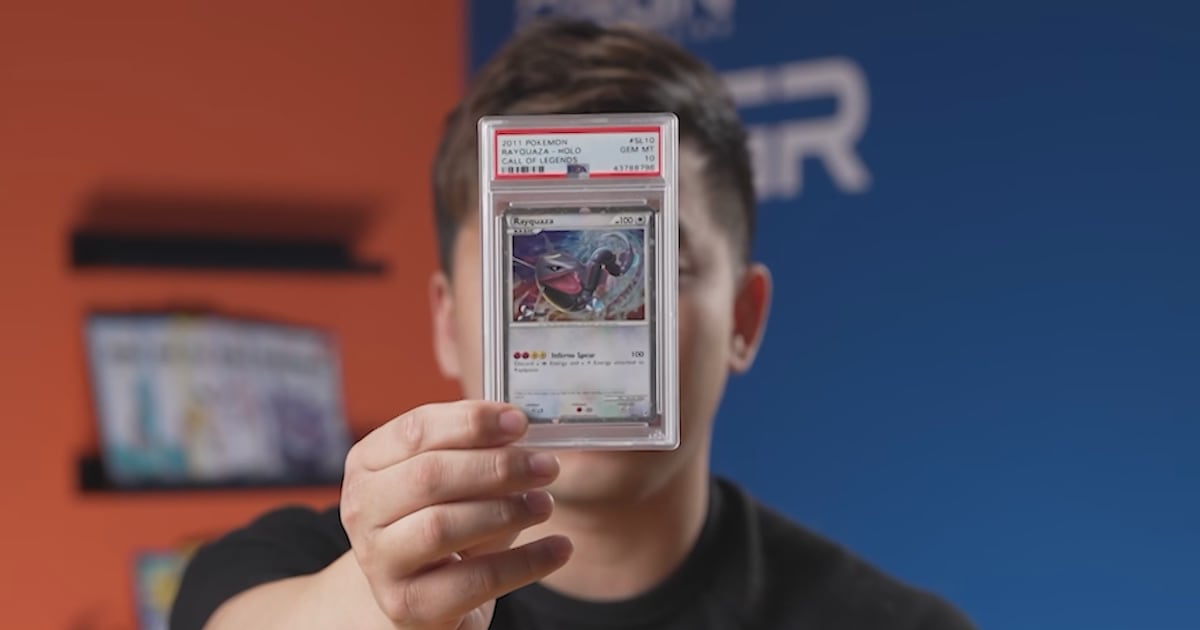
PSA has told CTV News that a Call of Legends Shiny Rayquaza sold as a PSA 10 sits in a fraudulent PSA holder. Jesse Peng, who owns a card shop in Richmond, British Columbia, says he paid US$660,000 for it. The card inside is believed to be real.
The Purchase
Peng owns a Pokémon card shop with his wife, and he told CTV News in a report published Nov. 11 that he had spent years trying to acquire this card in a PSA 10. "It's one of the rarest cards in the world," he said.
According to Peng, he paid US$660,000, about C$935,000, through a Pokémon card broker and completed the deal in cryptocurrency. "This is someone that I've seen do big deals in the past and has a pretty good reputation," he told CTV. "So I trusted the middleman's ability to authenticate the card."
The card arrived by courier. "When I received the card, I initially looked at it and I was like, this is the card of my dreams," Peng said. Dexerto, reporting on the purchase on Nov. 3, quoted him as saying, "It looked like a very clean card and the label looked very very real."
What He Noticed
Peng told CTV that a closer look turned up problems with the label. He then ran the card through software his tech startup is developing to identify counterfeit collectibles. "When I put it through our system, our system flagged it to being fake," he said. "I was so in denial that I was mad. I was like, if this is fake, then what is real?"
The detail he pointed to was a security feature. "The fugitive ink that was part of the PSA security label was wrong," Peng said.
What PSA Said
Peng sent the card to PSA for review. PSA told CTV News that its authentication process identified a fraudulent PSA holder associated with the card. CTV reports that the card itself is believed to be real, and that PSA determined it was not an authentic PSA 10.
PSA also told CTV that fraudsters have "become more sophisticated in producing deceptive cards and altered items." A PSA spokesperson said the company would not comment on active investigations. Emails obtained by CTV show PSA is working with law enforcement in Peng's case.
The broker declined CTV's request for comment. Peng told CTV he does not think the broker knowingly took part, though he believes the broker should be held accountable for the transaction. He is exploring his legal options. "Hopefully I can partially recover some of my lost funds," he said. "But if not, then it will be a very expensive learning lesson."
The Labels on AliExpress
A separate story broke the same week. On Nov. 10, Dexerto reported on an AliExpress listing offering custom PSA-style labels for almost any card, with front and back designs, barcodes, QR codes and a holographic patch. The listing, shown in a video shared by collectibles commentator Max Long, appeared to be priced at $4.05 with more than 5,000 sales displayed. Dexerto notes that the product is advertised as a customizable label, not as a PSA-graded collectible.
Roman Pioneer, founder of the authentication database CheckCOA, looked into the listing and others like it. According to Dexerto, he found AliExpress stores selling custom front and back labels alongside unsealed card cases. One store had reportedly sold 170 units. Its buyer photos showed labels carrying PSA certification numbers tied to a Paldean Fates Mew ex and a Rocket Dark Gyarados, and Dexerto reports that both numbers matched real PSA records.
Other labels in the reporting used a deactivated PSA number and an active number belonging to a GEM MT 10 One Piece Zoro card. A second store's product video showed a copied label tilted under a light so that its silver patch reflected much as the security feature on a genuine label does.
Dexerto also describes a listing in Japan for genuine PSA, BGS and ARS labels that had been removed from their original cases and were sold together for 6,800 yen. CheckCOA marked those loose labels as suspected, not confirmed, counterfeits.
Some collectors pushed back on the idea that the copies cannot be detected. Dexerto reports that they pointed to fugitive ink, print quality and missing security patterns. Fugitive ink is the same feature Peng says gave his holder away.
Neither CTV nor Dexerto connects the holder on Peng's card to the AliExpress listings.
What PSA Tells Buyers
PSA's statement to CTV included advice for buyers. "We strongly advise extreme caution when purchasing high-value, raw cards on peer-to-peer marketplaces," a spokesperson said. "When buying encapsulated cards, collectors should always verify the certification number and scans in PSA's public database, inspect the physical holder for tamper-evident features, and submit items for official review whenever uncertainty exists."
Peng offered his own advice through CTV: verify a high-value card independently before buying it, and avoid paying in cryptocurrency whenever possible.
Analysis: PSA's instruction has three parts, and the certification number is only the first. Dexerto's reporting shows why it cannot be the last. A copied label printed with a real, active number returns a genuine record when someone looks it up, with a card description and a grade that match what the label says. The scans in PSA's database and the holder in the buyer's hand are the two checks that involve the physical item.
Analysis: This blog has covered forged PSA labels before. CASE #0252 and CASE #0268 followed the Anthony Curcio prosecution, in which one operation took genuine PSA labels and altered the grades. The AliExpress listings Dexerto describes are a different kind of supply. They are made to order from details the buyer provides, and they are sold on an open marketplace with reviews.
Confidence note: Peng's account of the purchase, the US$660,000 price and its Canadian-dollar equivalent, his quotes, PSA's finding and statements, the broker's response and the law-enforcement detail are from CTV News (Nov. 11, 2026). One Peng quote is from Dexerto (Nov. 3, 2026). The AliExpress listings, the CheckCOA findings and the collector reactions are from Dexerto (Nov. 10, 2026). The price paid is Peng's account. Passages labeled Analysis are the blog's interpretation. Image: CTV News.