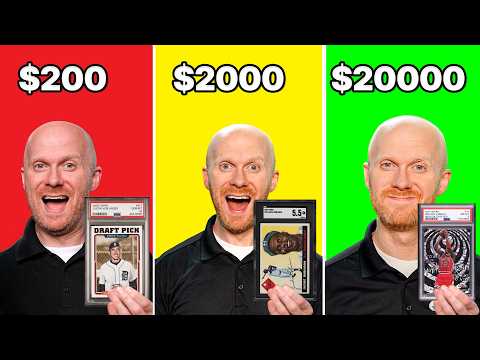
Video of the Day: How to Invest $200, $2,000, and $20,000 in Sports Cards Today
The hardest question in the sports card market today isn't "what's hot" — it's "where do I put my money?" Whether you have $200, $2,000, or $20,000 to deploy, the current market is treacherous: vintage is strong but expensive, modern is volatile, sealed wax is in correction, and the PSA backlog means grading timelines stretch for months.
Market Movers by Sports Card Investor recently published a framework that breaks down exactly this question — how to allocate capital across three budget tiers in today's environment. The video provides a useful starting point, but the blog has its own take on where the framework works and where it needs adjustment.
The $200 Tier: Singles, Not Boxes
At the $200 budget level, the conventional wisdom says to buy a hobby box and chase a hit. The video rightly pushes back on this — and the blog agrees. A $200 hobby box of almost any current product is a lottery ticket with terrible odds. You're buying the hope of a single big hit, not building a collection.
Instead, the $200 tier should be focused on singles:
- Hall of Famer rookies in PSA 8 or raw: Tony Gwynn, Cal Ripken Jr., Joe Montana — cards in the $30-80 range that have decades of collecting demand
- Modern stars in PSA 9 or PSA 10: A PSA 9 of a current superstar like Shohei Ohtani or Patrick Mahomes can be had for under $200
- Vintage commons in mid-grade: 1950s and 1960s cards in PSA 3-5 condition are undervalued relative to their scarcity
The one exception to the "no boxes" rule: if you can find retail product at MSRP, the math changes. But with retail shelves cleaned out by breakers and resellers, that's increasingly rare.
The $2,000 Tier: The Sweet Spot
The $2,000 tier is where the market gets interesting. This budget opens up genuine opportunities that aren't available at the entry level:
- Vintage entry: A lower-grade 1952 Topps Mickey Mantle (PSA 1-2) can be had in this range. It's the most iconic card in the hobby, and even low-grade copies appreciate with time.
- Key rookie cards in mid-grade: PSA 5-6 examples of stars like Derek Jeter '93 SP, Tom Brady '00 Bowman Chrome, or Kobe Bryant '96 Topps Chrome are accessible at this level.
- Modern case speculation: A single case of a high-end product like Topps Dynasty or Flawless gives you a shot at a major hit without the unlimited downside of buying individual boxes.
- Graded sealed wax: A PSA-graded 1980s or 1990s wax box is both a collectible and an investment vehicle with a transparent price history.
The blog's take: the $2,000 tier is where vintage beats modern every time. A $2,000 mid-grade Mantle or Jordan is more liquid, more historically significant, and less exposed to market trends than a $2,000 modern card of a player who might fall off next season.
The $20,000 Tier: Blue-Chip Territory
At $20,000, you're playing in a different league entirely. The rules change:
- Liquidity matters most: A $20,000 card needs a buyer when you want to sell. Stick to tier-one icons: Mantle, Ruth, Jordan, LeBron, Brady, Gretzky.
- Grade is everything: The difference between a PSA 8 and PSA 9 at this level can be $50,000+. Buy the best grade you can afford in the most iconic card you can find.
- Diversify across sports: Don't put $20,000 into one card. A portfolio of four $5,000 cards across football, baseball, basketball, and hockey is safer and more interesting.
- Avoid modern at this tier: A $20,000 modern card is a) incredibly risky and b) hard to sell. There are maybe 10 modern cards with consistent six-figure liquidity, and you're priced out of most of them at $20,000.
The video's framework works well at this tier, but the blog would add one critical point: the PSA backlog changes the math. With 10+ million cards in the grading pipeline, the supply of high-grade modern cards will increase dramatically over the next 12-18 months. That flood of supply will pressure prices on modern PSA 10s — but vintage cards are immune to this effect because their populations are fixed. At the $20,000 tier, vintage isn't just preferred — it's mandatory.
Where the Framework Falls Short
The video's tiered approach is a useful organizing principle, but it has blind spots:
- No consideration of the grading backlog: As noted above, the 10M-card PSA pipeline is going to reshape modern supply for years. Any allocation strategy that ignores this is incomplete.
- Underweights seasonal factors: Football cards peak in August-December, baseball in March-July, basketball during the playoffs. A smart strategy rotates capital across seasons, not just across tiers.
- Overweights sealed product: The video is more bullish on sealed wax than the blog's analysis supports. Sealed product has underperformed singles for 18 months, and the correction isn't over yet.
The Verdict
The Market Movers framework is a solid starting point for any collector wondering how to allocate capital in today's complicated market. The core insight — that different budget levels require completely different strategies — is correct and valuable.
But the blog's analysis suggests an adjusted framework: $200 = singles, $2,000 = vintage entry, $20,000 = blue-chip icons only. And at every tier, the grading backlog and seasonal rotation should inform your timing. The market is changing faster than any single video can capture — but a strategy built on liquidity, grade quality, and historical significance will weather whatever comes next.
Channel: Market Movers by Sports Card Investor