Card of the Day: 1979-80 Topps Wayne Gretzky Rookie #18
The 1979-80 Topps Wayne Gretzky rookie card isn't just the most important hockey card ever made — it's the bridge between vintage collecting and the modern era of sports cards as financial assets. In a market where every other category is under correction pressure, the Gretzky rookie keeps doing what it's always done: appreciating quietly, reliably, and permanently.
The Card
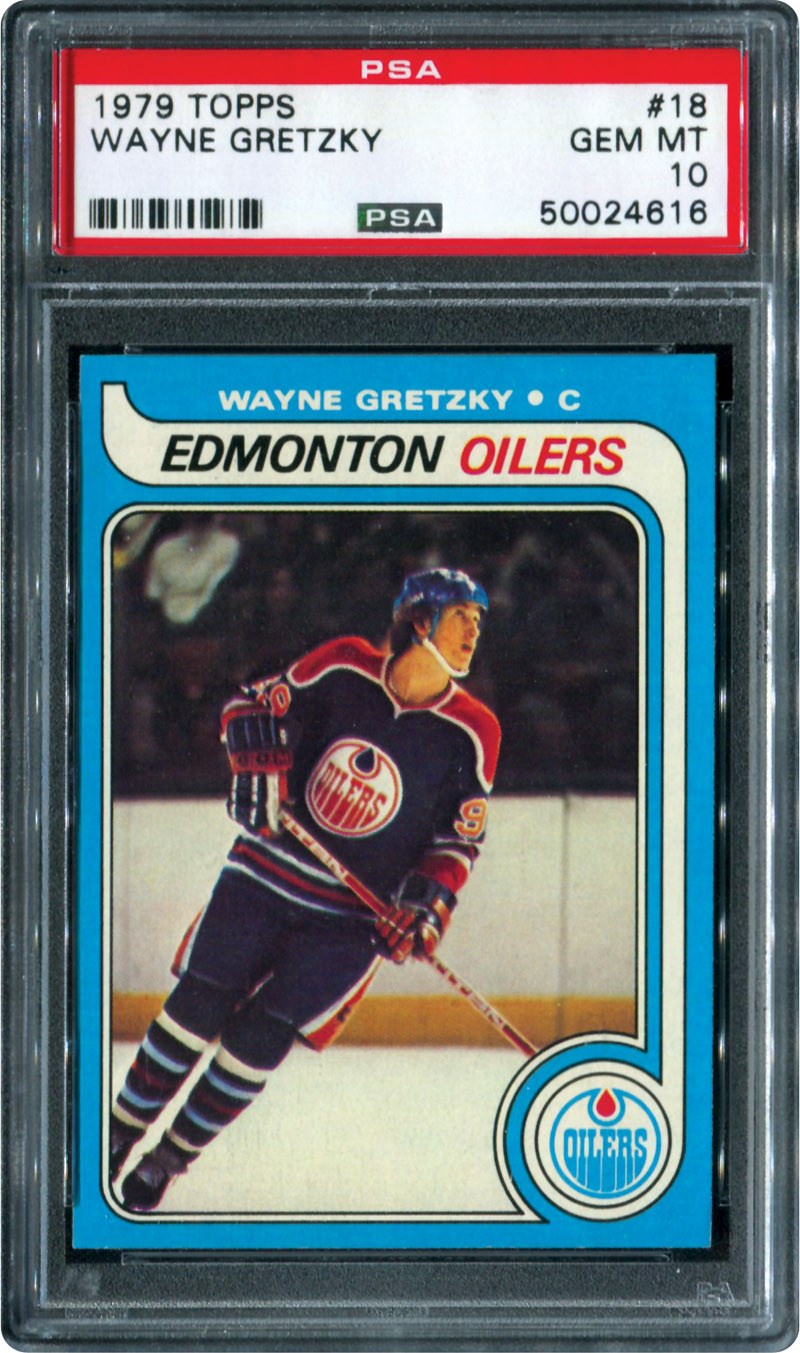
Card #18 in the 1979-80 Topps set captures an 18-year-old Wayne Gretzky in his Edmonton Oilers uniform — a clean portrait set against a blue border with the team name in block letters below. The card was printed at a time when hockey cards were still primarily a children's product. No one at Topps was thinking about PSA 10 populations or seven-figure auction results. They were printing cardboard for kids.
That factory-floor indifference is exactly why condition matters so much. The 1979-80 Topps set is notorious for poor centering, soft corners, and print defects. Finding a Gretzky rookie with four sharp corners and anything approaching 50/50 centering is a genuine rarity — and the pop report tells that story in brutal detail.
PSA Population Report
The numbers tell a story of extreme condition scarcity at the top:
| PSA Grade | Population | Value |
|---|---|---|
| PSA 10 | 1 | $2,000,000+ |
| PSA 9 | 127 | $80,000 - $100,000 |
| PSA 8 | 1,248 | $25,000 - $35,000 |
| Total Graded (All Grades) | 10,861 | — |
* Population data as of June 06, 2026.
Let those numbers sink in: out of roughly 8,000 submissions, fewer than 1,400 cards have achieved PSA 8 or better. That's condition scarcity at a level rarely seen outside pre-war baseball cards.
Why This Card Matters
Wayne Gretzky isn't just hockey's greatest player — he's one of the most statistically untouchable athletes in any sport. His career points record (2,857) is so far ahead of second place (Jaromir Jagr, 1,921) that it's effectively a different sport. Only two players in NHL history have more assists than Gretzky has total points. He holds 61 NHL records. The math is cartoonish.
For the hobby, Gretzky occupies a unique position: he's the "Mantle of hockey" — the vintage icon whose card defines the ceiling for the entire sport's collectibles market. When a Gretzky PSA 10 sells for a record price, it pulls up PSA 9s. When PSA 9s move, PSA 8s follow. The Gretzky rookie is the tide that lifts every hockey card boat.
The "Gretzky Premium"
The card market has a well-documented premium for "first among equals" — the single most important card in a sport's history. The 1952 Topps Mickey Mantle serves that role in baseball. The 1986 Fleer Michael Jordan does it for basketball. For hockey, it's the 1979-80 Topps Wayne Gretzky.
These cards share common characteristics: they're the rookie card of the sport's consensus greatest player, they come from an era before perfect-condition collecting was standard practice, and they have pop reports that guarantee permanent scarcity at the top. Unlike modern cards — where a 2024 rookie might have 50,000 PSA 10s within five years — the Gretzky PSA 10 population will likely never exceed single digits.
In a market flooded with manufactured scarcity, this is the real thing. There aren't more coming. There never were that many to begin with.
Verdict
The 1979-80 Topps Wayne Gretzky rookie is the anchor asset for the hockey card market — a blue-chip collectible with permanent condition scarcity, a population ceiling that cannot be cracked, and an athlete whose statistical dominance has no peer in any team sport. At current PSA 8 prices of $25,000–$35,000, it remains undervalued relative to its peers in baseball and basketball, where comparable "best in sport" rookie cards trade at multiples. The Gretzky premium isn't going anywhere. It's the default answer to the question: "If I could own one hockey card, which one?"